Where Wounds Live - A Collection of Articles in the Aftermath of Trauma (2026)
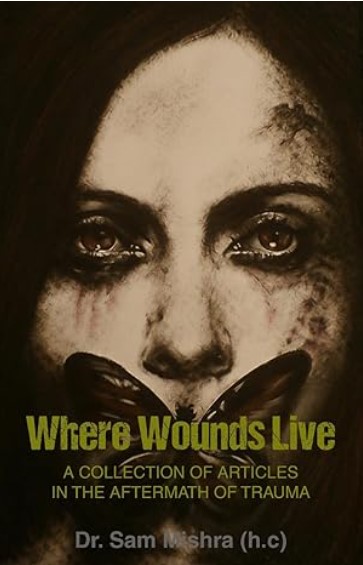
Where Wounds Live is a ground breaking collection of articles that takes you deep into the landscape of trauma — not to dwell there, but to find the way through.
Drawing on her background as a nurse, midwife, and trauma practitioner, Dr. Sam Mishra (hc) brings both clinical precision and hard-won personal experience to some of the most pressing and rarely spoken-about challenges of our time.
From the long shadow of narcissistic abuse and the silenced reality of male sexual assault, to addiction, body image, grief, generational trauma, and the quiet revolution of somatic healing — this book leaves no wound unexamined.
Spanning 67 articles across ten powerful themes, Where Wounds Live refuses to simplify what is complex or sanitise what is painful. Instead, it offers something rarer: honest, compassionate, and deeply human understanding. Whether you are navigating your own recovery, supporting someone who is, or working on the frontline of trauma care, these pages will challenge what you think you know — and illuminate what you may never have considered.
This is not just a book about surviving trauma. It is a guide to understanding where it lives inside us, and what it takes to truly come home to ourselves.
Peer Reviews
“In Where Wounds Live, Dr. Sam Mishra (h.c.) delivers a profound and symphonic exploration of the human spirit’s capacity to endure and rebuild after the devastating impact of trauma. This collection of 67 articles is far from a standard clinical manual; instead, it serves as a deeply personal homecoming for the wounded healer and anyone navigating the aftermath of abuse, loss, or systemic failure. Drawing from her own lived experience—including the heart-wrenching loss of her children and her personal journey through domestic abuse - Dr. Mishra bridges the gap between medical science and holistic healing with rare authenticity. She rejects the sterile, detached perspective of traditional therapy in favour of a "Language of Safety," reframing traumatic symptoms not as signs of "brokenness," but as the body’s adaptive survival strategies.
Where Wounds Live is ultimately a transformative guide that honours the whispers of the body before they become screams, offering a lantern to those walking through the fire, and proving that the self waiting on the other side has not just survived, but fundamentally and beautifully rearranged.”
- Alessandro Franchina - Business Writer and Adviser, Published Poet,
“Where Wounds Live is not just a collection of articles, it is a deeply compassionate guide through the often unspoken realities of trauma and recovery. Dr. Sam Mishra brings together clinical insight, lived experience, and courageous honesty to illuminate the hidden ways trauma shapes our lives, relationships, and sense of self. In a world where trauma is often misunderstood or minimized, this book stands as both a mirror and a map. It helps readers recognize their own stories while offering language, frameworks, and hope for healing.
Where Wounds Live is more than a book, it is a resource, a companion, and for many, a turning point.”
— Heidi Richards Mooney - Publisher, WE Magazine for Women | Author, The Expectant Author Series
Dr. Sam Mishra’s Where Wounds Live is one of those rare books that doesn’t just inform you — it stays with you. As someone who has interviewed authors from all walks of life on the UK Talk Radio Breakfast Show, I can tell you this is not a lightweight, surface-level read. It goes into places many people avoid talking about, and it does so with honesty, intelligence, and real compassion.
What impressed me most is that Dr. Mishra writes from both professional experience and personal understanding. That combination gives the book real authority. You can feel that these subjects are not being approached from a distance or treated like academic theories.
Whether she’s discussing narcissistic abuse, addiction, grief, body image, generational trauma, or the often-overlooked subject of male sexual assault, there’s a sense throughout the book that the reader is being understood rather than judged.
The structure of the book works very well too. With 67 articles spread across ten themes, you can dip into different sections depending on where you are emotionally or what subject speaks to you most.
Some chapters are challenging, and they should be. Trauma is complicated, messy, and deeply personal. What this book does brilliantly is refuse to oversimplify any of it.
I also think the sections on somatic healing are particularly interesting because they introduce readers to the idea that trauma isn’t just something we think about — it can live physically inside us as well. That’s an area more people are beginning to understand, and this book explains it in a very human and accessible way.
This isn’t a book full of clichés or quick-fix solutions. It’s thoughtful, grounded, and courageous. It feels written by someone who genuinely wants to help people make sense of what they’ve lived through and begin moving forward.
If you work in care, support someone dealing with trauma, or you’re trying to understand your own experiences a little better, Where Wounds Live is a powerful and important read.
Reviewed by Geoff Carter, host of the UK Talk Radio flagship Breakfast Show.
If we know where the wounds live, we can begin to heal. This powerful collection is a lifetime of work, and if it can serve and soothe even one person, the world will be better for it. Surely it will serve so many.
- Sierra Melcher, Author and CEO of Red Thread Publishing.
Editorial Feature
The Cartography of Wounds: Navigating the Inner Landscape of Trauma
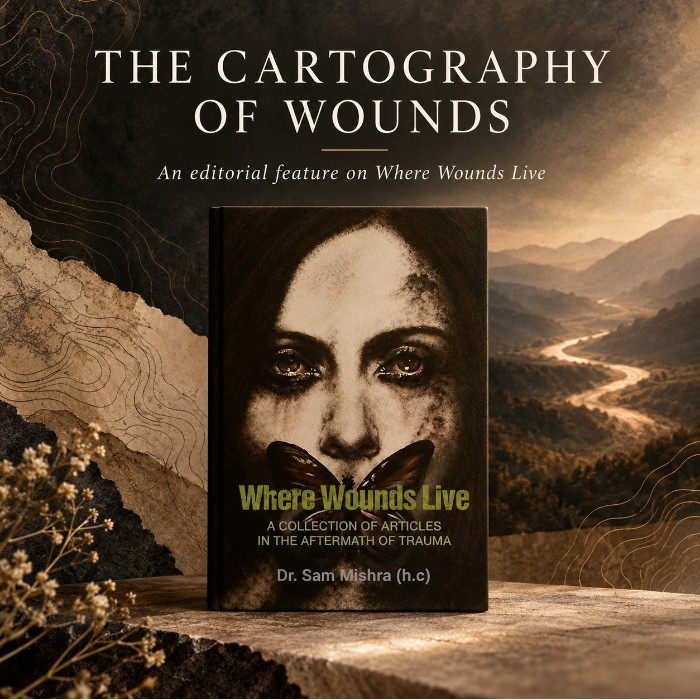
On Where Wounds Live by Dr Sam Mishra (2026)
In a world quick to offer quick fixes, a new collection of articles invites us into a deeper, more honest conversation about where trauma truly resides, and the arduous, essential journey of returning to ourselves.
There are places within us that remain uncharted — territories of pain and resilience that we often navigate in solitude, guided only by flickering lanterns of memory and instinct. These are the spaces where our wounds live, not as static scars but as dynamic presences, shaping our interactions, our perceptions, and the quiet architecture of our everyday lives.
Where Wounds Live, Dr Sam Mishra's new collection, which arrived this April, takes this metaphor seriously. To map something is to admit it has shape, contour, and consequence — that it can be traced, if not fully explained. Mishra resists the language of trauma as a single event to be "resolved," and instead treats it as terrain: layered, shifting, and deeply personal. Some regions are marked clearly, named and dated. Others exist only as a felt sense — a tightness in the chest during an ordinary conversation, a flinch with no obvious cause, a pattern repeated across relationships until it finally demands to be seen.
Beyond the Quick Fix
Contemporary culture is fluent in the shorthand of healing — five-step frameworks, viral affirmations, the promise that peace is one more purchase or practice away. What this collection pushes back against is the flattening of trauma into a problem with a clean solution. Instead, it asks a harder and more honest question: what does it actually mean to live alongside what has happened to us, rather than simply move past it?
This is not a rejection of hope. It's a recalibration of what hope looks like when it's earned rather than promised. The essays gathered here seem less interested in offering a map out of pain than in teaching readers how to read the map they're already standing on — to recognize the landmarks, understand why certain paths were carved the way they were, and find, gradually, a way to move through the landscape with more agency than before.
The Body as Terrain
A recurring thread in trauma-informed writing — and one Mishra leans into throughout — is the understanding that wounds are rarely confined to memory alone. They settle into the body: in posture, in breath, in the nervous system's readiness to brace for danger long after the danger has passed. To navigate the inner landscape of trauma, then, is also to navigate the physical one — learning to notice where the body holds tension, where it goes still, where it still, quietly, keeps watch.
This somatic dimension is part of what distinguishes a genuinely useful trauma resource from a merely comforting one. It doesn't ask readers to think their way out of pain. It asks them to feel their way through it, with patience, and often with support.
Solitude, and the End of It
Perhaps the most quietly radical idea running through this framing is the acknowledgment of solitude — that so much of this navigation happens alone, in the private hours when no one else can see the terrain we're crossing. Naming that solitude is itself an act of care. It tells the reader: you are not imagining the difficulty of this, and you are not wrong for finding it hard.
But a collection like Mishra's also exists to interrupt that solitude, at least partially. Reading someone else's honest cartography — their false starts, their unexpected clearings, their long detours — offers a kind of companionship that self-help absolutism rarely provides. It says: others have walked difficult ground too, and here is what they found.
Why It Matters Now
We are living through a moment of unprecedented openness about mental health, paired, somewhat paradoxically, with unprecedented impatience for resolution. Algorithms reward the tidy takeaway. Attention spans shrink around anything that can't be summarized in a slide. Against that backdrop, a collection willing to sit with complexity — to say this will take longer than you want it to, and that's not a failure — is a genuinely countercultural offering.
Where Wounds Live doesn't promise readers a way out. It offers something arguably more valuable: a way in — a set of tools, perspectives, and permissions for facing the inner landscape honestly, at whatever pace that landscape demands.
For readers drawn to trauma-informed writing that values depth over speed, and honesty over easy resolution, Dr Sam Mishra's Where Wounds Live offers a place to begin — or to continue — the work of returning to oneself. Published 2026.