
From The Wreckage: A Journey Through Shame, Fear and Rebirth of the Self. (Coming Early 2027)
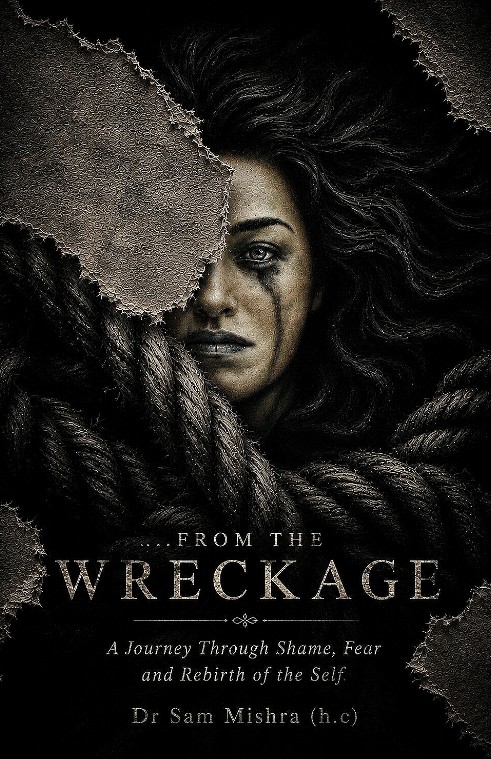
There is a moment this book keeps returning to: a knife, and a man who did not yet believe his life was worth saving. Dr. Sam Mishra was there for it — not as a clinician, but as someone who loved him.
From the Wreckage moves between those two vantage points: the person inside addiction, and the person standing beside them, trying to hold on. Drawing on her clinical background in trauma and addiction work and her own history of self-harm, disordered eating and complex PTSD, Mishra dismantles the idea that addiction is a moral failing. In its place, she offers something more precise and more human — addiction as adaptation, shame as its hidden engine, and recovery as a non-linear, often circular process of rebuilding a self once the coping mechanism is gone.
This is not a clean redemption story. It traces the unpredictable house of a childhood shaped by another's addiction, the dissociation that once felt like safety, the exhausting work of compliance and people-pleasing, the specific grief of loving someone who leaves the moment they arrive at stability, and the question underneath all of it: who are you, when the thing you used to survive is no longer available to you?
Part memoir, part clinical field guide, From the Wreckage is for anyone who has stood in the ashes of addiction — their own, or someone else's — and wondered whether there was a way back to themselves. There is. It rarely looks like a straight line. This book maps it anyway.
Editorial Feature
From The Wreckage
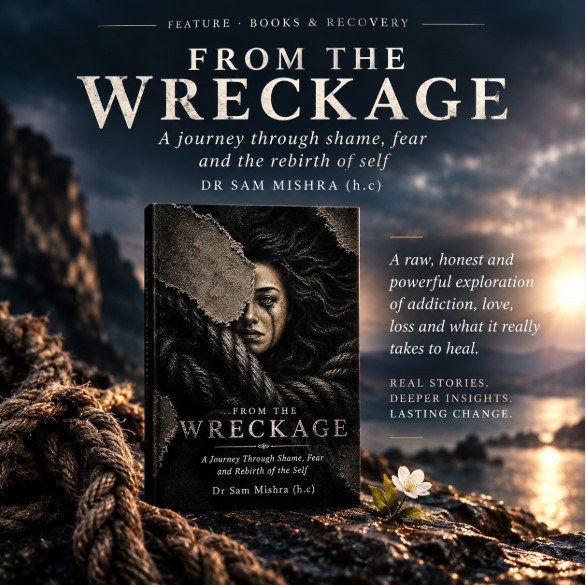
A trauma therapist nearly lost the man she loved to addiction and self-harm. Her new book turns that night, and everything after it, into a map of shame, survival and the long, unglamorous work of becoming someone again.
There is a scene early in Dr Sam Mishra's new book that most readers will not be able to put down, and will wish, a little, that they could. A woman walks into a room and finds a knife at the throat of the man she loves. She talks him through it, twice more, before the night is over. She does not sleep. She does not leave the room to use the bathroom, in case he wakes and tries again. She sits, and watches him breathe, and prays in the way people pray once they have stopped quite believing prayer changes anything, but do it anyway.
That night is the seed of From the Wreckage: A Journey Through Shame, Fear and the Rebirth of Self, Mishra's third book and by some distance her most personal. Mishra is a trauma practitioner, hypnotherapist and former nurse and midwife who has spent two decades sitting across from other people's pain professionally. This time, the pain sitting across from her belonged to someone she loved, and no amount of clinical training, she writes, prepared her for living inside it herself.
Not a Memoir, Not a Manual
Mishra is careful, in her preface, to resist both labels that a book like this might reach for. It is not a straightforward memoir, though the relationship that runs through it — with a man to whom the book is dedicated — supplies its emotional spine. Nor is it a clinical manual, though its chapters move with real rigour through attachment theory, dissociation, relapse models and the neuroscience of dopaminergic reward. Instead it sits deliberately between the two registers, using one to interrogate the other.
The effect is a book that reads less like a self-help title and more like an extended, honest argument: that addiction is not a moral failing to be diagnosed and managed, but an adaptation — a strategy, however costly, for surviving feelings that once had nowhere else to go. “Why did anyone need somewhere to go that badly,” is the question Mishra says the book keeps circling back to, chapter after chapter, rather than the more familiar and less useful “how did this happen to him.”
Two People in the Same Wreckage
What distinguishes the book most from the recovery-literature shelf it will sit on is its insistence on telling both stories at once. Alongside the chapters on trauma, denial and relapse sits an equally developed thread on what Mishra calls the people who love the addicted: the ones who pull the knife away, sit awake through the night, drive someone to the door of the place that might save them, and then have to work out who they are once the crisis has passed and the relationship, in her own case, did not survive it. Their fear, she argues, and their grief when it comes, deserve the same honest reckoning usually reserved for the person in recovery.
It is a case made from lived experience as much as professional conviction. Mishra writes candidly about her own history of self-harm and disordered eating, and about losing people she loved to alcohol long before Tob's story began. The book's authority comes less from clinical distance than from its refusal of it.
Shame, Not the Substance, as the Engine Room
The book's clearest and most repeated idea is a distinction Mishra borrows from the psychology of shame and guilt, then builds an entire framework around: guilt says I did something bad; shame says I am bad. Guilt, she writes, leaves a door open, because a specific act can be apologised for and repaired. Shame closes it, because there is nothing to repair — only a self to keep hidden. She traces how that hidden self feeds the very behaviour it is ashamed of, tightening rather than loosening with every cycle, and argues that recovery is largely the slow work of moving a person from one sentence back to the other.
It is a small reframe with large consequences, and it is typical of how the book operates throughout: taking language that sounds almost too simple to be clinical, and using it to do real diagnostic work. A companion chapter on loneliness follows the same logic — a person uses because using briefly resembles connection, and then the using isolates them further, deepening the very loneliness that started the cycle.
From Statistics to a Single Room
Structurally, From the Wreckage moves outward before it moves inward. Its opening section sets addiction against its public cost in unsentimental detail — England's alcohol-related economic burden, hospital admissions, the rising toll of liver disease — establishing that what looks like a private struggle is, at scale, a public one. From there the book narrows steadily: to family and attachment, to the inner architecture of trauma and dissociation, to the specific clinical terrain of denial, and finally to the long, non-linear work of sustained recovery and repair. A reader can arrive at the intimate scenes of the preface already holding the wider picture that makes them legible.