
Published Books
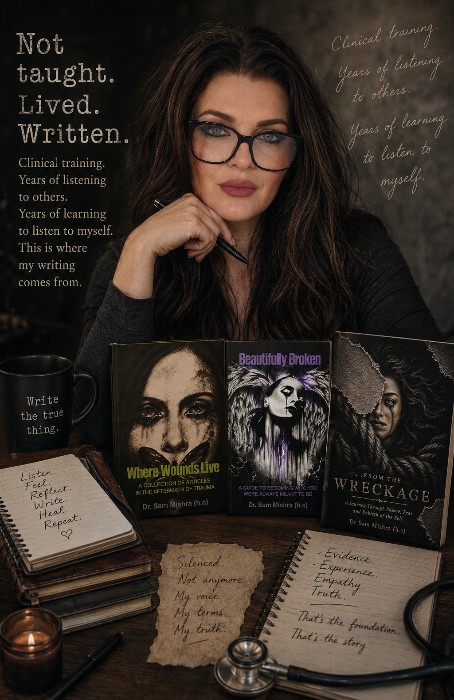
From the Page to the Practice
Being an author changes how you show up in the treatment room. When you've spent months, sometimes years, turning lived experience into language, you develop a particular kind of listening. You learn to hear the story beneath the story — the detail a client almost skips over, the pause that carries more than the sentence around it.
Writing teaches patience with the unfinished, the unresolved, the messy middle. That patience translates directly into how you sit with someone mid-crisis, mid-disclosure, mid-breakthrough.
Authors also understand narrative structure in a way most clinicians never have to. You know that trauma doesn't move in straight lines, that meaning gets made in retrospect, that people often need to tell their story more than once before they can hear it themselves. That understanding shapes how you guide a session — not toward a tidy resolution, but toward the next honest sentence.
And it runs the other way too. The treatment room feeds the page. Every session where someone finds the words for something they've never said aloud reminds you what language can do — and can't. Clinical training sharpens your writing with precision: you stop romanticizing pain and start representing it accurately, respectfully, without exploiting it for effect.
The two disciplines aren't separate skill sets running in parallel. They're the same instinct — paying close attention to how people make sense of what's happened to them — expressed in two different rooms.
Sometimes Your Greatest Strength Comes From What You Have Survived
I could give you a list of the obstacles in my life. A narcissistic mother. An absent father. Domestic abuse. Three pregnancies lost. Surgery after surgery, and a chronic pain condition. Long-term depression. Complex PTSD. Sexual assault. Addictive tendencies. Self harm and suicidal ideation. Three nervous breakdowns. The complicated, prolonged grief of losing two of my children. Watching other people try to end their own lives.
Any one of those things could have finished someone. Half of that list could have finished someone. I carried all of it.
For a long time I didn't have words for any of it — just the weight of it. Writing is where I finally found my voice. Not to perform the pain, but to make sense of it, to put it down on the page where I could look at it properly instead of just carrying it. Every book I've written has that survival in it somewhere, whether it's named outright or just underneath the words.
I didn't write my story so people would feel sorry for me. I wrote it so that someone in the middle of their own version of it — their own losses, their own breaking point — would read it and know they're not alone, and that surviving doesn't mean you're broken. It means you're still here.
If you're in it right now, I need you to hear this: you have not failed. You are not what happened to you. You are worth more than you realise.
Why do these subjects and telling my story matter to me as a writer?
For so long, I was told my pain wasn't real. Sharing my story is how I reclaim my truth — it's how I affirm, to myself and to anyone listening, that what happened to me actually happened. Retelling it helps my brain make sense of the chaos. It's part of how I integrate what I went through instead of letting it control me. Every time I put the story into words, I understand it a little more. After years of isolation, I long to be understood. Telling my story is how I connect with others who've lived through something similar — people who don't need it explained to them, because they already know.
I was conditioned to protect my abuser's image, to stay quiet so the peace wouldn't be disturbed. Speaking out now is my way of breaking that cycle of secrecy. I won't carry that silence for someone else anymore. Each time I tell it, I shift a little further from victim to survivor. I'm not just the person the story happened to — I'm the one telling it now, and that's a kind of power nothing can take back.
I know my story could reach someone else who's living what I lived. If it helps even one person feel less alone, then my suffering means something beyond just pain — it becomes purpose. The more I share, the less control the memory has over me. Every time I speak it out loud, I release a little more of what I've carried in silence for years, and in the process I rebuild my own identity more, finding not only my voice, but also my self-worth.
Abuse tried to erase who I was. Writing my story is how I find my way back to myself — my voice, my strength, my worth. It's how I remember who I am.