
Beautifully Broken: A Guide to Becoming Who You Were Always Meant To Be
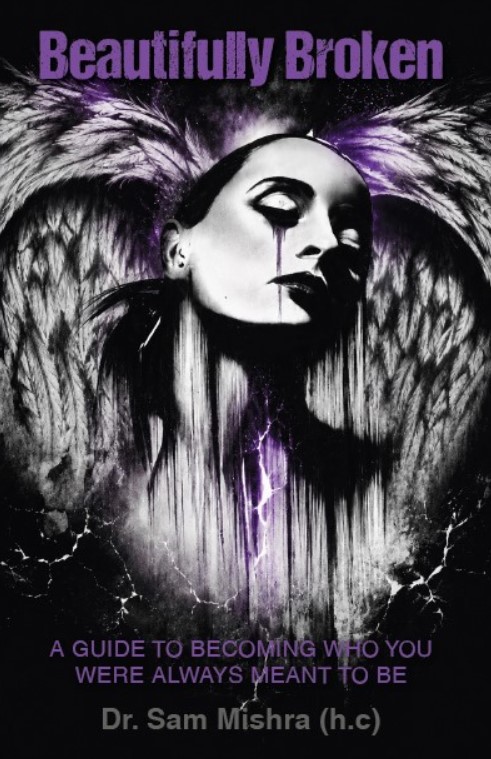
What if the very things that broke you were always meant to make you?
Beautifully Broken is a raw, compassionate, and deeply practical guide to becoming who you were always meant to be — not despite your wounds, but through them.
Drawing on three decades of clinical practice as a trauma practitioner, nurse, midwife, and transformational coach, Dr Sam Mishra (h.c.) weaves together the neuroscience of trauma, depth psychology, somatic wisdom, and her own unflinching personal story to offer a roadmap for genuine, lasting change.
This is not a book about quick fixes or toxic positivity. It is an honest reckoning with the unconscious patterns, personality archetypes, and relational wounds that quietly shape our lives — and a step-by-step journey through the inner landscape most of us spend a lifetime avoiding. From shadow work and inner child healing, to trauma bonding, the Drama Triangle, and the Hero's Journey, each chapter moves you closer to the most authentic and empowered version of yourself.
Organised around the same transformational framework that has changed hundreds of lives in Dr Mishra's acclaimed workshops, Beautifully Broken meets you exactly where you are — and walks with you toward who you are capable of becoming.
Because you were never broken beyond repair. You were always becoming.
The sequel to Where Wounds Live.
Peer Reviews
'Having read Where Wounds Live, I was eager to read Dr. Sam Mishra’s follow-up, and it did not disappoint. While the first book helped me understand the lasting impact of trauma, grief, addiction, and family dynamics, this book feels like the next step—it doesn't just explain why we think and behave the way we do, it helps us begin to change it.
Drawing on the Transformation Workshops, Dr. Mishra gently guides readers through practical exercises that encourage honest self-reflection and a deeper understanding of the patterns that keep us stuck. What I appreciated most was how compassionate and accessible the book is. It never feels overwhelming or judgmental but instead offers hope and practical ways to move forward.
Whether you're carrying unresolved trauma, struggling to break free from unhealthy cycles, or simply wanting to understand yourself better, this book provides a safe and empowering place to begin. It's a valuable companion for anyone ready to heal, grow, and create lasting change. I would highly recommend it to anyone looking to move forward with greater self-awareness and confidence.'
Carlie Evans - Author
"What struck me first when reading Beautifully Broken, is the honesty of the frame. Dr. Sam Mishra opens not with theory but with a dedication to "the little girl who was handed a verdict instead of a future." This isn't written at a safe distance from pain — it comes from her own history and her work as a trauma practitioner. Clients can tell when someone is theorising about resilience versus someone who has rebuilt themselves. This reads like the latter.
I liked how the material moves from concept into practice. Chapters on Conscious Commitment, the Drama Triangle, Inner Child, and Shadow cover familiar ground, but the somatic, felt-sense work threaded through is genuinely useful. Writing a commitment with the dominant and non-dominant hand, noticing where fear sits in the body, is simple enough for a session yet lands with weight — I could hand it to a client tomorrow.
This book sits between a client workbook and a memoir-informed guide and I would absolutely keep it on my bookshelf to use with clients working through relationship patterns and inner-child wounding. It asks readers to listen to their pain rather than bypass it — rarer than it should be."
— Heather Nugent - Life Coach & Writer
“She's a trauma practitioner who has spent years teaching people to put themselves first — and then goes home and does the opposite. She's built a career on helping others heal while quietly holding herself together with her own two hands. That honesty is rare in this genre, and it's exactly what makes the teaching land. This isn't a guru telling you what healing should look like. It's someone who has lived inside the theory and is willing to admit where it still fails her.”
Robyn Clifford - Counsellor
“There are plenty of books that promise to change your life. Some offer a collection of positive thoughts, a few exercises and the reassuring message that everything will be fine if only you learn to think differently.
Beautifully Broken is not that kind of book.
Dr Sam Mishra takes on something considerably more difficult: why experiences from our past can continue to influence the way we think, behave and form relationships long after we believe we have moved on from them, and that is where this book becomes interesting.
One of the strengths of Beautifully Broken is that it doesn’t treat personal change as something that happens simply because we decide we want it. Mishra explores the patterns we develop, the roles we fall into and the emotional wounds we may carry without fully understanding how much influence they still have. The book moves through subjects including trauma, shadow work, inner-child healing, personality archetypes, trauma bonding and the Drama Triangle. There is also discussion of the Hero’s Journey and the idea that difficult periods of our lives can become part of a much larger process of change.
That sounds like a lot of psychological territory to cover, and it is. Yet the book doesn’t read like a textbook. Mishra draws on three decades of clinical experience as a trauma practitioner, nurse, midwife and transformational coach, while also bringing elements of her own story into the discussion. That personal element matters. It gives the book warmth and prevents it from feeling like somebody standing at a distance explaining how everyone else should live.
There were moments when I found Beautifully Broken uncomfortable. I actually think that is one of the best things I can say about it. A worthwhile book about personal change shouldn’t allow the reader to sit comfortably on the sidelines. At various points you may recognise a behaviour, relationship or emotional response and think, “I do that.” Those are probably the most valuable moments in the book.
Rather than presenting the reader as somebody who needs fixing, Mishra encourages us to become curious about why we behave as we do. Where did this pattern begin? Why do certain situations provoke such a strong response? Why do we repeatedly find ourselves in similar relationships or circumstances? The questions are sometimes easier to ask than to answer.
Another thing I appreciated is the absence of relentless positivity. Life can be painful. Relationships can damage us. Childhood experiences can leave their mark. People sometimes make terrible decisions and occasionally repeat those decisions despite knowing better. Beautifully Broken doesn’t pretend otherwise.
Instead, the book’s central argument is that understanding those experiences can give us an opportunity to stop being unconsciously controlled by them. That distinction is important. The past cannot be rewritten, but our relationship with it can change.
I wouldn’t recommend racing through Beautifully Broken over a weekend. This is one of those books where a few pages can give you enough to think about for the rest of the day. Some readers may even find themselves putting it down occasionally because something they have read has struck rather closer to home than expected.
That isn’t a criticism. In fact, I suspect readers who are prepared to stop, reflect and question themselves will get considerably more from the book than those simply trying to reach the final page.
You don’t need to have studied psychology to understand this book. It will probably appeal most strongly to readers interested in personal development, relationships, emotional patterns and understanding how earlier experiences can continue to shape adult life. It may also appeal to people who have read self-help books before and come away frustrated by simplistic advice.
Mishra isn’t offering a magic morning routine or suggesting that repeating a positive phrase in front of the bathroom mirror will suddenly transform your life. The work she describes is deeper and inevitably messier than that. The title Beautifully Broken initially sounds like a contradiction. By the end of the book, it makes considerably more sense. The scars, mistakes and difficult experiences we accumulate aren’t necessarily separate from the people we eventually become. Sometimes they are part of the process.
What impressed me most about Dr Sam Mishra’s book is that it manages to discuss some complicated and emotionally difficult subjects without losing sight of the human being reading it. It doesn’t promise an easy transformation. Instead, it asks for something much more realistic: honesty, curiosity and a willingness to look at the parts of ourselves we might normally prefer to avoid.
Beautifully Broken is ultimately a book about understanding where you’ve been, recognising what you have carried with you and deciding what you want to carry forward, and perhaps that is a far more useful definition of personal change than simply trying to become somebody new.“`
- Danny Cooper, Book Editor, UK Talk Radio
Editorial feature
Beautifully Broken: Learning to Live in the Aftermath
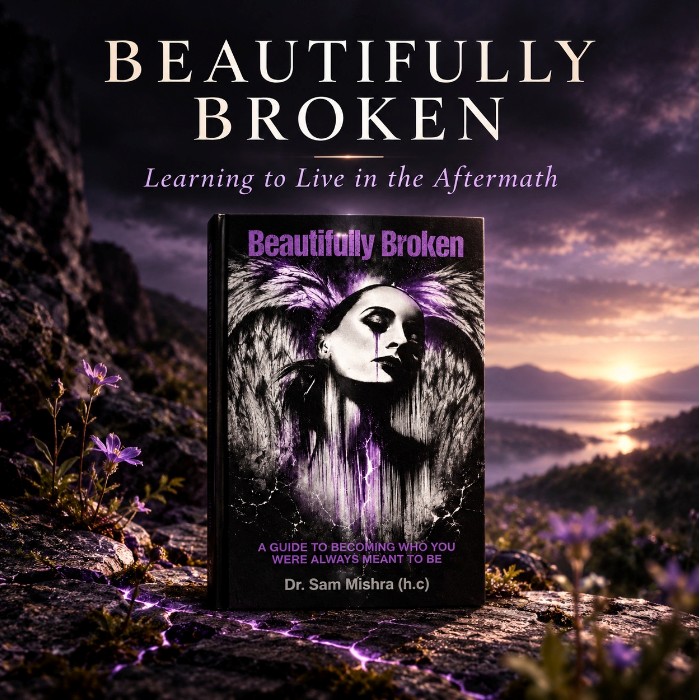
On Beautifully Broken by Dr Sam Mishra (2026)
After mapping the inner landscape of trauma, Dr Sam Mishra returns with a collection that asks a quieter, harder question: not how we survive our wounds, but how we learn to live — fully, imperfectly — around them.
If Where Wounds Live was an act of cartography — naming the terrain, tracing its contours, giving language to pain that had long gone unspoken — then Beautifully Broken is what comes after the map is drawn. It is the harder, slower work of habitation: learning to build a life on ground that will never again be entirely level.
This is a natural, almost inevitable next step. Understanding where a wound lives is only the beginning. The real work — the work most trauma writing shies away from — is figuring out how to keep walking, working, loving, and hoping on land that has been permanently reshaped. Mishra's follow-up seems to take up precisely that challenge.
The Myth of the Finished Self
Much of contemporary healing culture is built on an implicit promise: that with enough insight, enough therapy, enough time, a person eventually arrives somewhere whole — repaired, resolved, done. Beautifully Broken pushes against that promise, and in doing so offers something more honest. Brokenness, in this framing, is not a temporary state on the way to wholeness. It is, for many people, simply the shape a life takes — and it can still be a shape worth living in.
This isn't resignation. It's a different definition of strength: not the erasure of what happened, but the capacity to carry it without being wholly defined by it. The title itself does real work here — it refuses to separate "beautiful" from "broken," insisting instead that they can, and often do, coexist in the same body, the same relationship, the same ordinary Tuesday morning.
From Diagnosis to Daily Life
Where a first book on trauma often has to do the foundational work of naming and validating pain, a follow-up has room to go further into the granular, unglamorous texture of living with it: the friendships that require renegotiation, the small daily choices that either reinforce old patterns or quietly begin to loosen them, the moments of unexpected joy that can feel almost like a betrayal of the pain that came before.
It's in this territory — the in-between, unphotogenic middle of recovery — that a second book earns its place. The dramatic breakthroughs are rarer than the culture suggests; what actually accumulates, over months and years, is a thousand small acts of choosing differently. Beautifully Broken appears to be interested precisely in that unglamorous accumulation.
A Companion Volume, Not a Sequel
Read alongside Where Wounds Live, this new collection functions less like a sequel and more like a companion — two halves of a longer conversation. The first book asks readers to look honestly at where they've been hurt. The second asks something arguably more difficult: to look honestly at who they're becoming because of it, and to find, if not peace exactly, then something more durable — a kind of steady, clear-eyed self-acceptance.
Why This Book, Now
Trauma-informed writing has proliferated in recent years, but much of it still gravitates toward the moment of rupture — the wound itself, freshly named. Fewer books are willing to sit in the long aftermath: the years and decades after, when the crisis has passed but the reshaping remains. Dr Sam Mishra's Beautifully Broken steps into that gap, offering readers not a promise of repair, but permission — to be unfinished, uneven, and still, unmistakably, whole enough.
Beautifully Broken by Dr Sam Mishra is published in 2026, following her debut collection Where Wounds Live.